



Wisdom Tooth Removal in Vilnius: Safe Surgery
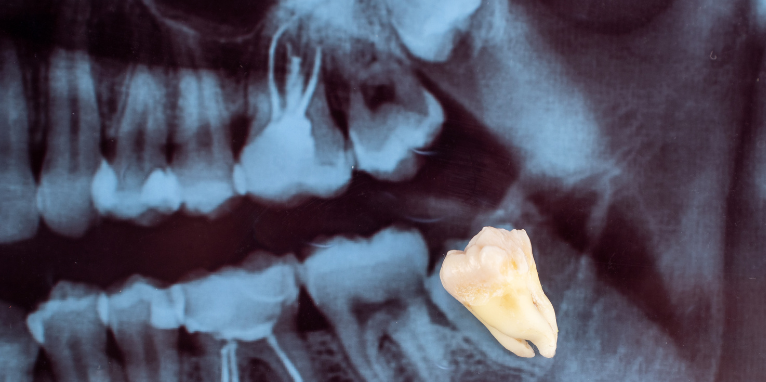
Wisdom tooth removal is one of the most common surgical procedures in dentistry. In our clinic, eighth tooth removal is performed using modern techniques and quality anesthesia, which ensures painlessness and comfort for the patient. Wisdom teeth, or third molars, erupt at the age of 18-25 and often cause various problems due to lack of space in the dental arch. Our specialists have extensive experience in removing wisdom teeth of any complexity and help patients get rid of pain and discomfort.
We understand that patients often fear this procedure, have heard stories about difficult removal and long recovery. In our dentistry, we use atraumatic techniques, carefully plan the operation based on X-rays, use effective anesthesia and provide detailed care recommendations after removal for quick healing.
Why Wisdom Teeth Cause Problems
Wisdom teeth appeared in humans in the process of evolution for chewing rough food. Modern diet has become softer, human jaws have decreased, and there is often not enough space left for eighth teeth. In our clinic, we observe that in many patients wisdom teeth erupt partially, remain under the gum or in the bone, grow at an angle, rest against adjacent teeth. Such incorrect position is called dystopia or retention.
Our specialists note that even fully erupted wisdom teeth are often located in a hard-to-reach place where it is difficult to maintain quality hygiene. This leads to plaque accumulation, caries development on the eighth and seventh teeth, gum inflammation around the wisdom tooth. Eighth tooth roots may have a complex shape, be curved, intertwined, which complicates their treatment. Therefore, in our dentistry, we often recommend prophylactic removal of problematic wisdom teeth.
Indications for Wisdom Tooth Removal
In our clinic, we recommend wisdom tooth removal in the presence of indications. The most common indication is pericoronitis, inflammation of the gingival hood over a partially erupted tooth. Food debris gets under the hood, bacteria multiply, painful inflammation develops with swelling, suppuration, difficulty opening the mouth. Our specialists with recurrent pericoronitis recommend tooth removal, as inflammation will recur.
We remove wisdom teeth with their incorrect position, when they press on the adjacent seventh tooth, causing its destruction, root resorption. Removal is indicated when caries develops on the eighth tooth, especially if its treatment is difficult due to poor access. In our dentistry, we recommend removal during orthodontic treatment, when the wisdom tooth interferes with the movement of other teeth, creates crowding. Also, removal is necessary when cysts and other pathological formations form around the impacted tooth.
Diagnosis Before Removal
Before wisdom tooth removal in our clinic, thorough diagnosis is mandatory. Our specialists perform radiological examination to assess tooth position, number and shape of roots, their relation to anatomical structures. It is especially important to determine the distance to the mandibular canal when removing lower eighth teeth, as the neurovascular bundle passes through the canal, damage to which can lead to complications.
We use panoramic X-ray or targeted X-ray depending on the situation. On the X-ray, our doctors assess the degree of tooth retention, inclination of its axis, condition of surrounding bone tissue, presence of pathological changes. This information allows us to plan the operation course, prepare necessary instruments, warn the patient about possible procedure complexity. In our dentistry, we always show the patient the X-ray and explain the removal plan.
Preparation for Wisdom Tooth Removal
Special preparation before wisdom tooth removal in our clinic is usually not required. Our specialists recommend patients eat 1-2 hours before the procedure, as after removal it will be impossible to take food for several hours. It is necessary to thoroughly brush teeth before the visit. We advise avoiding alcohol consumption before removal, as this reduces anesthesia effectiveness and increases bleeding risk.
When removing against inflammation background – pericoronitis, periostitis – in our dentistry, preliminary anti-inflammatory treatment may be required. Our doctors prescribe antibiotics several days before surgery to reduce inflammation and lower risk of infectious complications. For patients with comorbidities taking anticoagulants, we recommend consultation with the attending physician for therapy correction. Before removal, we explain the procedure course in detail, answer all patient questions.
Anesthesia During Removal
In our clinic, wisdom tooth removal is performed under quality local anesthesia, which completely eliminates pain during surgery. Our specialists use modern articaine-based anesthetics with vasoconstrictor, which provide deep and long-lasting pain relief lasting 2-3 hours. This is sufficient for comfortable performance of even complex removal and provides pain relief in the first hours after the procedure.
For upper wisdom teeth removal in our dentistry, infiltration anesthesia is usually sufficient – infiltration of the area around the tooth. For lower eighth teeth, our doctors use conductive mandibular anesthesia – mandibular nerve block, which anesthetizes the entire half of the lower jaw. Additionally, infiltration anesthesia is performed from the cheek and tongue side. We wait for complete anesthesia onset before starting removal, check sensitivity.
Simple Wisdom Tooth Removal
Simple removal in our clinic is performed when the wisdom tooth has fully erupted, has normal position, is accessible for grasping with instruments. Our specialists use special forceps for eighth teeth with elongated narrow beaks. We apply forceps to the tooth crown, advancing them under the gum, perform rocking movements to destroy ligaments holding the tooth in the alveolus.
After achieving mobility, our doctors remove the tooth from the socket with a smooth movement. We examine the removed tooth, make sure of root integrity. Then we perform socket revision, remove granulation tissue, bone fragments, irrigate with antiseptic solution. In our dentistry, with simple removal, suturing is usually not required. A sterile tampon is placed on the socket, which the patient bites for 20-30 minutes for blood clot formation.
Complex Wisdom Tooth Removal
Complex removal in our clinic is required with tooth retention, its incorrect position, curved roots, destroyed crown part. Our specialists perform atypical removal using surgical techniques. We start with an incision on the gum to create a mucoperiosteal flap, which we separate to provide access to the bone and tooth.
If necessary, our doctors remove part of the bone tissue covering the tooth using a bur and physiodispenser with water cooling. This allows exposing the crown and tooth neck for its grasping. If the tooth has several roots or is positioned horizontally, in our dentistry we perform separation – sawing the tooth into parts, after which each fragment is removed separately with an elevator. This is less traumatic than trying to extract the tooth whole.
Operation Completion
After wisdom tooth extraction in our clinic, thorough wound treatment is performed. Our specialists smooth sharp bone edges with burs, remove bone filings, irrigate the wound with antiseptic solutions – chlorhexidine or physiological solution. We examine the socket, make sure there are no root fragments, bone fragments, foreign bodies.
Then our doctors place the mucoperiosteal flap back and suture the wound. In our dentistry, we use absorbable or non-absorbable sutures depending on the situation. Sutures promote better healing, protect the socket from food entry, reduce bleeding and inflammation risk. When using non-absorbable sutures, we schedule suture removal after 7-10 days. The patient is given detailed care recommendations and control examinations are scheduled.
Recommendations After Removal
After wisdom tooth removal in our clinic, we give patients detailed recommendations for successful healing. The sterile tampon on the socket should be bitten and held for 20-30 minutes for blood clot formation, then carefully removed. You cannot eat for 2-3 hours while anesthesia is working. The first day you should eat only warm soft food, chew on the opposite side.
Our specialists strictly warn that you cannot rinse your mouth on the first day, so as not to wash out the blood clot from the socket. From the second day, you can make baths with antiseptic – chlorhexidine or chamomile decoction. We recommend avoiding physical exertion, overheating, not visiting bath, sauna for the first 3-5 days. Do not smoke for at least 2-3 days, consume alcohol, touch the socket with tongue, toothpicks. It is better to sleep on a high pillow to reduce swelling.
Drug Therapy After Removal
After wisdom tooth removal in our clinic, drug therapy is prescribed for complication prevention and postoperative period relief. Our specialists recommend taking painkillers – ibuprofen, ketoprofen, nimesulide. They not only relieve pain but also reduce inflammation and swelling. It is better to take painkillers by the clock for the first 2-3 days, without waiting for severe pain.
With complex removal, removal against inflammation background in our dentistry, we prescribe broad-spectrum antibiotics for a course of 5-7 days for infectious complication prevention. Our doctors recommend antihistamines to reduce swelling, especially when removing lower wisdom teeth. We may also prescribe vitamins, calcium preparations to accelerate healing. It is important to take all prescribed medications according to the scheme and not stop taking them prematurely.
Possible Complications
In our clinic, we perform wisdom tooth removal in compliance with all protocols to minimize complication risk. However, patients should know about possible situations. The most common complication is alveolitis, inflammation of the removed tooth socket. It develops when the blood clot falls out or decays, wound infection. Manifested by increasing pain on days 2-4, bad breath, gray coating in the socket, sometimes temperature rise.
Our specialists urge immediately contacting our dentistry when these symptoms appear. We will perform alveolitis treatment – socket treatment under anesthesia, necrotic tissue removal, irrigation with antiseptics, laying medicinal drug. You should also contact us with prolonged bleeding more than 3-4 hours, severe increasing swelling, difficulty swallowing or breathing, numbness of lip, chin, tongue persisting more than a day. Our doctors will provide necessary assistance.
Swelling and Pain After Removal
Swelling and pain after wisdom tooth removal in our clinic is a normal body reaction to surgical intervention. Our specialists warn that swelling increases in the first 2-3 days after removal, especially with complex removal of lower eighth teeth. This is due to soft tissue trauma during surgery. To reduce swelling, we recommend applying cold to the cheek in the removed tooth area on the first day – for 15-20 minutes every hour.
Pain after anesthesia wears off is a natural phenomenon. In our dentistry, we prescribe effective painkillers that well control pain syndrome. Pain should gradually decrease day by day. Our doctors note that on days 3-4 after removal, pain and swelling begin to subside. If pain increases, swelling increases, temperature appears – these are signs of complications, and it is necessary to contact our clinic for examination.
Healing After Removal
The healing process after wisdom tooth removal in our clinic takes several weeks. On the first day, a blood clot forms, filling the socket and protecting it from infection. On days 3-5, granulation tissue formation begins. Our specialists note that by the end of the first week, soft tissues significantly heal, pain and swelling decrease, the patient returns to normal lifestyle.
Complete soft tissue healing in our dentistry occurs in 2-3 weeks. Socket filling with bone tissue takes 2-3 months, after which the bone levels with the surrounding jaw surface. We schedule control examinations 1-2 days after removal to assess the healing process, remove sutures if necessary. Our doctors monitor dynamics and adjust appointments if necessary. Compliance with all recommendations ensures fast and safe healing.
When to Preserve Wisdom Tooth
Despite frequent problems with wisdom teeth, in some cases in our clinic we recommend preserving them. Our specialists do not remove eighth teeth if they have fully erupted, are correctly positioned, have an antagonist tooth and participate in chewing. With a healthy wisdom tooth with good hygiene and no problems, removal is inappropriate.
We preserve wisdom teeth if they can serve as support for a bridge prosthesis in the absence of adjacent teeth. Also in our dentistry, the eighth tooth can be preserved for subsequent transplantation to the place of the removed seventh molar. Our doctors individually assess each situation and make a decision on the advisability of preserving or removing the wisdom tooth based on the clinical picture, X-rays, patient wishes.
Frequently Asked Questions
Is wisdom tooth removal mandatory?
Not always. In our clinic, we recommend wisdom tooth removal only in the presence of indications – inflammation, incorrect position, pressure on adjacent teeth, caries development. If the eighth tooth has fully erupted, is correctly positioned, does not cause problems, participates in chewing – our specialists recommend preserving it. We conduct an examination, take an X-ray and assess the wisdom tooth condition individually. Prophylactic removal without indications is not performed in our dentistry.
How long does wisdom tooth removal take?
The duration of the procedure in our clinic depends on case complexity. Simple removal of a fully erupted upper wisdom tooth our specialists perform in 15-20 minutes. Lower eighth tooth removal usually takes 20-30 minutes. Complex removal of impacted, malpositioned tooth with the need for incision, bone removal, separation may require 40-60 minutes. We work carefully and thoroughly to perform the operation as atraumatically as possible.
How long does it hurt after wisdom tooth removal?
Pain and discomfort after removal is a normal reaction that we warn our patients about. With simple removal, pain usually goes away in 2-3 days. After complex removal, discomfort may persist for 5-7 days, gradually decreasing. In our clinic, we prescribe effective painkillers that well control pain syndrome. Our specialists note that with compliance with all recommendations, most patients feel comfortable already 3-4 days after surgery.
Can two wisdom teeth be removed at once?
In our clinic, removal of two wisdom teeth in one visit is possible, but our specialists usually recommend removing them alternately. With simultaneous removal of two teeth on one side, the patient will be able to chew on the opposite side. However, swelling and discomfort will be more pronounced. We do not recommend removing teeth from both sides simultaneously, as this will significantly complicate food intake in the postoperative period. Our doctors assess the patient's condition, complexity of the upcoming removal and make a decision individually on the number of teeth to be removed per visit.